


The Sinulog Festival: History, Meaning and the Bisaya You Hear
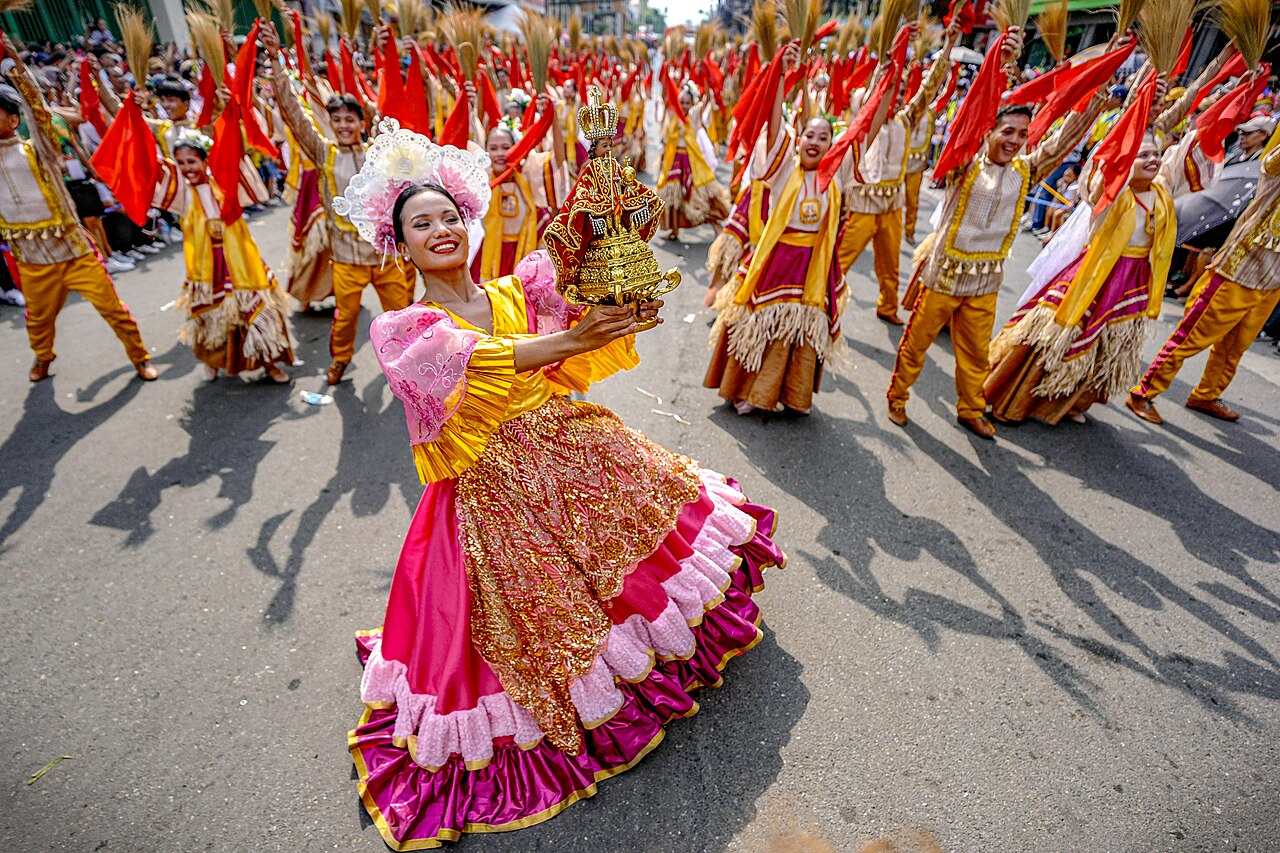
Sinulog is colour, drums and enormous crowds, but reducing it to a street party misses its centre: devotion to the Santo Niño and a dance tradition tied deeply to Cebuano religious and cultural life.
What you’ll learn
The bigger picture before you dive in
Where the name Sinulog comes from.
How devotion to the Santo Niño sits at the heart of the festival.
How the modern parade grew around older religious traditions.
What “Sinulog” means
The Sinulog Foundation connects the name to the Cebuano word sulog, meaning a water current. The characteristic dance movement is often described as echoing the motion of flowing water.
The connection with sulog, a water current, helps explain the festival’s signature movement: dancers often step forward and back in a flowing rhythm. That movement makes the dance visually distinctive and also shows how a single Cebuano word can contain cultural meaning that is hard to capture through a simple dictionary translation.
The Santo Niño connection
The Santo Niño image is linked to the 1521 encounter in Cebu, when an image of the Child Jesus was given to Queen Juana after baptism. Devotion continued and became a major part of Cebu’s religious identity.
The Santo Niño is not merely a festival mascot. For many devotees the image has deep religious significance, and processions, Masses and prayer are central to the season. Visitors who focus only on costumes and street dancing can miss the devotional heart of the celebration. Understanding that religious dimension makes the spectacle more meaningful and encourages respectful participation.
The modern festival
Traditional devotional dancing long predates the large organised street festival. The modern civic parade developed in 1980 and grew into a major cultural and tourism event, while the religious feast and devotion remain central for many participants.
The large civic festival familiar today developed in the modern era, growing into an enormous public event involving dance contingents, music, tourism and city-wide organisation. Its scale is modern, but it draws on much older devotional practices. This combination of old faith and new spectacle is one reason Sinulog feels both traditional and contemporary.
Words behind the spectacle
Visitors hear Bisaya constantly during Sinulog: directions, greetings, food orders, chants and everyday conversation. Learning the language helps you tell the lived local celebration apart from the version seen only through photographs.
For a learner, Sinulog is a flood of real language. Announcements, jokes, directions, food orders and conversations happen around you at speed. Even recognising a few familiar Bisaya words can be exciting because the language stops being a lesson exercise and becomes part of a huge shared public event.
The key takeaway
Sinulog makes the most sense when you see the celebration, the Cebuano language and devotion to the Santo Niño as parts of one cultural experience.
Speak like you are there
Useful Bisaya from this story
Turn the story into something you can say.
Discovering Cebuano culture makes the language memorable. Speak Bisaya connects that context to pronunciation, stories, practical phrases and structured learning.
Keep exploring
Cebu
Cebu City: From Sugbu to a Modern Metropolis
The colourful history of Cebu City from the precolonial port of Sugbu through Spanish settlement and twentieth-century urban growth.
Read nextCebu
Cebu: The Island Where History and Bisaya Meet
Cebu from precolonial Sugbu through 1521 and 1565 to the modern island where Cebuano/Bisaya remains part of daily life.
Read nextCulture
Cebuano Food, Markets and the Bisaya Words Visitors Should Know
Practical Bisaya around food, markets and meals, and why eating together is such a useful doorway into everyday Cebuano conversation.
Read next